Right now
Stress, as it happens.
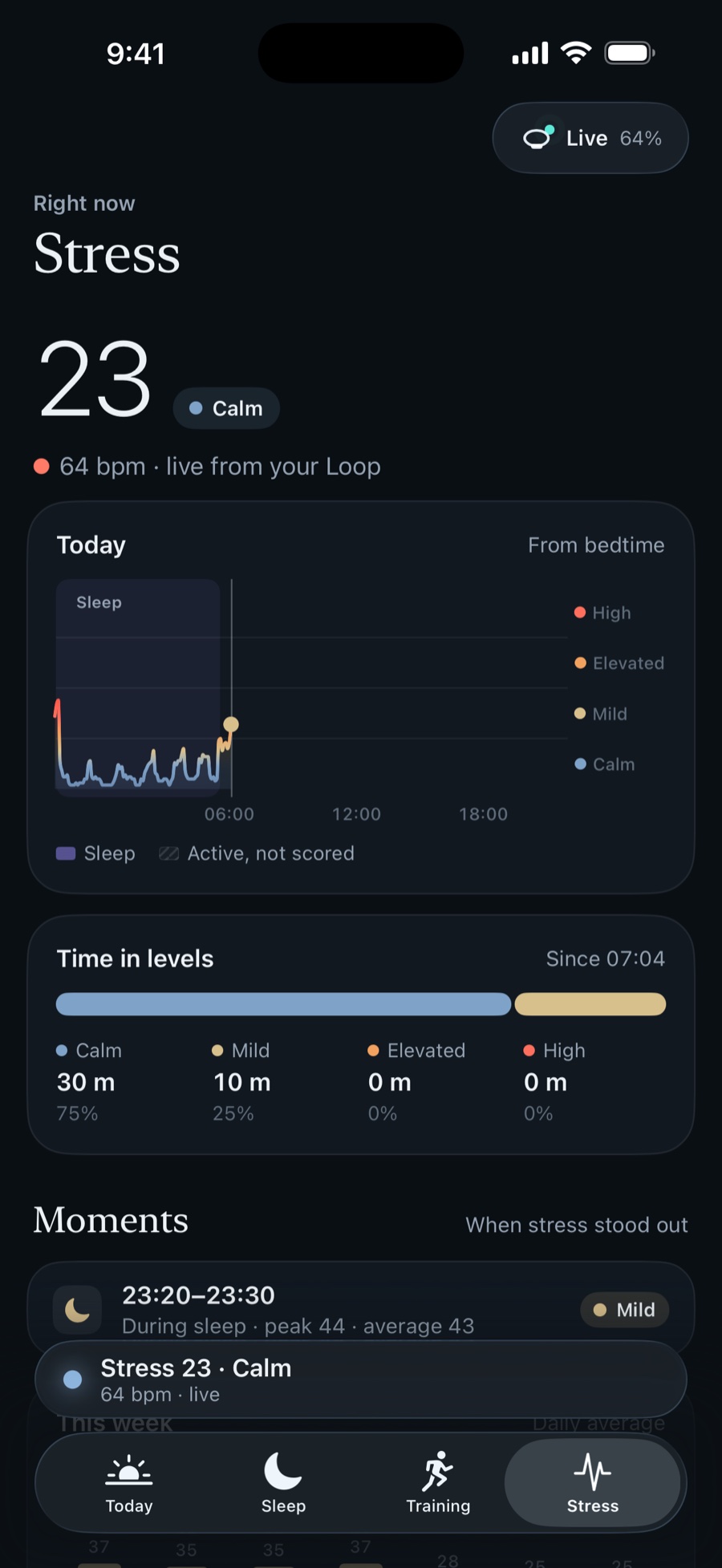
Keely’s Stress is a score from 0 to 100. In 5-minute windows, it compares your heart rate and heart-rate variability with your own calm, awake reference while you’re still. While you move, it reads your heart rate alone, on the same scale, so the day has one line.
Updated
- Levels
- Calm 0–25, Mild 26–50, Elevated 51–75, High 76–100
- Still
- Heart rate and RMSSD over 5 minutes, from at least 20 clean beat pairs
- Moving
- Heart rate alone, from your calm (20) to your maximum (100)
- Compared with
- Your own calm and awake reference, learned from your still time
- Live
- With your Loop connected and Keely open
- Otherwise
- From the Loop’s 24/7 data at each sync, with its time
- Moments
- 10 minutes above 50 by day, or above 30 at night
What the score means
- Calm 0–25
- Mild 26–50
- Elevated 51–75
- High 76–100
Sitting calm and awake reads about 20; deep sleep reads about 2. A heart rate 8 beats a minute above your calm with 30 % less variability reads 60, Elevated. 20 beats above with half the variability reads 93, High.
Stress says what your heart is doing, not why. Anything that raises your heart rate or lowers your HRV while you sit still reads the same way: a tense meeting, caffeine, a warm room, a big meal, alcohol or illness.
Still or moving
Keely reads every 5-minute window that has heart rate, whatever you’re doing, and every number counts it: now, the timeline, time in levels, the averages and moments. What you’re doing only picks the method. A window is Active when:
- any minute in it has more than 10 steps, or the Loop rates it as more than light activity;
- it overlaps a workout;
- your heart rate is at or above your Zone 1 floor, which catches rides and lifting that barely move the wrist.
After activity, a window is settling while your heart rate is more than 15 beats a minute above resting: for up to 30 minutes after a workout, and up to 10 minutes after a walk.
Active and settling windows are read from your heart rate alone, as body stress, between your calm and your maximum:
C           = resting HR + calm
Body stress = 20 + 80 × (HR − C) ÷ (max HR − C)
Calm and awake reads 20 on both scales, and your maximum heart rate reads 100. With a resting heart rate of 51 and a maximum of 185, a walk at 95 beats a minute reads 41 (Mild), the Zone 1 floor at 118 reads 56 (Elevated), and a threshold run at 165 reads 87 (High).
On the timeline it’s one line. Scrub a stretch where you moved and it says “from heart rate”, and the time in levels card shows how much of the day was read this way, with its peak. Behind the line, only your workouts from Training are marked.
How the score is computed
While you’re still, both signals are compared with a calm and awake reference built on your nightly baselines. Everyone starts at their resting heart rate plus 12 beats a minute, and about 78 % of their nightly HRV. Then Keely learns your own: from the still, awake windows of your last 14 days, it moves toward where you actually sit when calm, a little at a time and within bounds (8 to 16 beats a minute above resting).
zHR    = (HR − (resting HR + calm)) ÷ 8
zRMSSD = (ln RMSSD − (ln nightly HRV − calm HRV)) ÷ 0.35
s      = 0.9 × zHR − 0.9 × zRMSSD
Stress = 100 ÷ (1 + e^−(s − 1.4))
Without enough clean beats for RMSSD, heart rate carries the reading alone: s = 1.2 × zHR.
Until you have 3 nights, Keely uses your profile’s resting heart rate (or 60) and an HRV of 45 ms, and treats the reading as provisional.
Live and stored
- Live. With your Loop connected and Keely open, heart rate and beat intervals stream from the band, and the score covers the last five minutes once they hold two minutes of heart rate. The same rule picks the method: a minute where the Loop flags at least half its beats for movement or lost contact counts as moving, and the reading comes from heart rate alone.
- Stored. The rest of the time, Keely scores the Loop’s 24/7 data when it syncs, and labels the reading with its time, such as “As of 11:20”. Gaps stay gaps.
Moments
A moment is when stress stood out: at least two windows in a row (10 minutes) above 50 during the day, or above 30 at night, still or moving. Moments show on the timeline, day and night. One that’s mostly moving is named by the workout under it, or Active, until you tag it.
Frequently asked questions
Why is my stress high when I feel calm?
Stress reads your heart, not your mood. Caffeine, heat, a big meal, alcohol, illness or a hard day behind you can raise your heart rate and lower your HRV while you sit still, and Keely can’t tell those apart from a tense moment.
Does exercise count as stress?
Yes, as stress on your body. While you move, Keely reads stress from your heart rate alone, on the same scale, and counts it like any other reading: a threshold run can read High, an easy walk Mild. The time in levels card shows how much of your day was read while you moved.
Why does it say Active when I’m sitting down?
Your heart rate may still be settling after a workout or a walk, or the Loop may have flagged movement in the last few minutes. Until then, Keely reads your stress from heart rate alone. The reading with HRV returns once you’ve been still and your heart rate is back near your calm.
Is Keely’s Stress a measure of anxiety?
No. It’s a physiological estimate from heart rate and HRV for wellbeing, not a psychological or medical assessment.
Keep reading
We may earn a commission when you buy through this link. As an Amazon Associate, Metrica Fit earns from qualifying purchases. Keely is an independent app and isn’t affiliated with or endorsed by Polar Electro.