Every Monday
Keely Age: your fitness, in years.
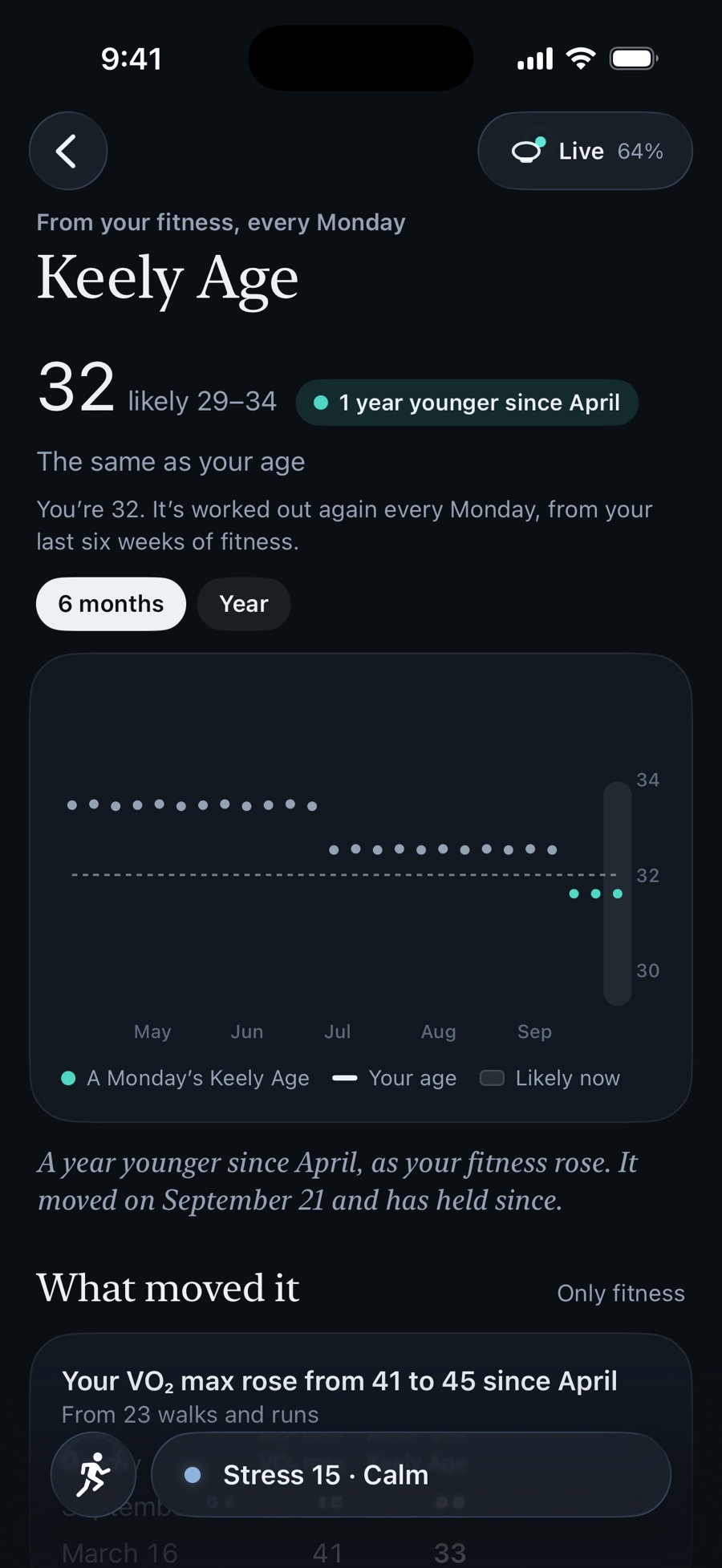
Keely Age is your fitness in years. Across large studies, fitter people have lower mortality at the same age. Keely Age is the age whose average mortality risk matches fitness like yours: if yours is higher than average for your age and sex, your Keely Age is younger than you are. It comes from your VO2 max and nothing else, and it’s worked out each Monday.
Updated
- From
- Your VO2 max, against the average for your age and sex
- Each point of VO2 max
- About half a year (a MET, 3.5 points, is about 1.6 years)
- Updated
- Each Monday, from your last six weeks of fitness
- Shown
- In whole years, with a likely range of about 2½ years either way
- Needs
- Established fitness: 3 steady walks or runs, and your max heart rate
- Isn’t
- A forecast of your lifespan, a diagnosis, or a promise
How it’s worked out
Across the large studies, each MET of fitness (3.5 points of VO2 max) goes with about 14 % lower mortality, and mortality rises about 9.6 % with each year of age. Put together, a MET is worth about 1.6 years:
Keely Age = age + ln(0.86) ÷ 3.5 ÷ 0.0917 × (VO₂ max − average)
          ≈ age − 0.47 × (VO₂ max − average)
The average is the FRIEND registry’s median for your age and sex, the same tables as your fitness band, so your band and your age always agree.
For example: a man of 40 has an average of 40.1. With a VO2 max of 52, 11.9 above it, his Keely Age is 40 − 0.47 × 11.9, about 34: 6 years younger than he is. A woman of 40 with a VO2 max of 44 is about 33.
Why only fitness
In large studies, cardiorespiratory fitness is one of the strongest predictors of how long people live. Resting heart rate, HRV, sleep and steps matter too, but they overlap with fitness and with each other, so adding their risks together would count the same thing twice. Keely Age leaves them out of the number and shows them beside it instead, on its page, never turned into years.
How it changes
- Each Monday, from your fitness as it stood that morning. It holds through the week.
- Over six months, Keely names a change, such as “1 year younger since April”, only once your VO2 max has moved by a full MET. Less than that is within the estimate’s noise, and it reads steady.
- What moved it is always the same one thing: your VO2 max. The page lists the Mondays it changed, with the VO2 max behind each.
- When it moves, Today says so once, that Monday: “Your Keely Age is 38 now”, and why.
Before it has a number
Keely Age waits for established fitness: 3 steady walks or runs that agree, and your max heart rate, seen in a hard effort or set in Settings. Until then, its card shows what’s done and what it’s waiting for, with no number and nothing guessed.
What it is, and what it isn’t
- It is a way to read your fitness against the evidence on fitness and mortality, in units you live in.
- It isn’t a forecast of how long you’ll live. It compares risks at your age; it doesn’t move a lifespan.
- It isn’t a biological age from blood or DNA, and it isn’t a diagnosis.
- It describes people like you, not a promise about you. The studies are of populations, and the link is a little weaker at older ages.
If a medicine or condition changes how your heart rate responds, Keely doesn’t estimate your fitness, so there’s no Keely Age either.
Frequently asked questions
How is Keely Age different from a fitness age?
A fitness age usually asks at what age your VO2 max would be average. Keely Age instead uses the evidence on fitness and mortality, which moves much less for the same change in VO2 max: about half a year a point. That keeps it steady, and honest about how sure it can be.
Why didn’t it change this week?
It’s worked out each Monday, and over six months it only names a change once your VO2 max has moved by a full MET (3.5 points). Smaller moves are within the estimate’s noise.
Can I lower my Keely Age?
It follows your fitness. In the studies behind it, people who are fitter have lower mortality at the same age. More steady aerobic work raises VO2 max for most people, and Keely Age follows when it does.
Is Keely Age the same as WHOOP Age?
No. Keely Age comes only from your VO2 max, and its formula is on this page. WHOOP Age combines nine measures of sleep, strain and fitness, as WHOOP describes on its own pages. See Keely and WHOOP.
What about other wearables’ ages?
Garmin’s Fitness Age, Oura’s Cardiovascular Age and Ultrahuman’s Cardio Age are each built their own way, from different measures. The comparisons describe each one, with its sources.
Does it need a subscription?
No. Keely is free, with your Polar Loop.
Sources
- Fitness and mortality, per MET: Singh B et al. Comparison of objectively measured and estimated cardiorespiratory fitness to predict mortality. J Sport Health Sci 2025. doi:10.1016/j.jshs.2024.100986; and Kodama S et al. Cardiorespiratory fitness as a quantitative predictor of all-cause mortality and cardiovascular events. JAMA 2009. doi:10.1001/jama.2009.681
- Mortality’s rise with age: Liu Z et al. A new aging measure captures morbidity and mortality risk across diverse subpopulations from NHANES IV. PLoS Med 2018. doi:10.1371/journal.pmed.1002718
- Turning a risk into years: Brenner H et al. Rate advancement periods. Epidemiology 1993. doi:10.1097/00001648-199305000-00006; and Spiegelhalter D. How old are you, really? Communicating chronic risk through ‘effective age’ of your body and organs. BMC Med Inform Decis Mak 2016. doi:10.1186/s12911-016-0342-z
- A clinical precedent, from treadmill tests: Blaha MJ et al. Cardiorespiratory fitness and biological age. Heart 2016. doi:10.1136/heartjnl-2015-308537
- Reference averages: Kaminsky LA et al. Reference standards for cardiorespiratory fitness (FRIEND). Mayo Clin Proc 2015. doi:10.1016/j.mayocp.2015.07.026
Keely is not a medical device. Keely Age isn’t a diagnosis or a prediction for any one person.
Keep reading
We may earn a commission when you buy through this link. As an Amazon Associate, Metrica Fit earns from qualifying purchases. Keely is an independent app and isn’t affiliated with or endorsed by Polar Electro.