Every morning
Recovery: last night against your normal.
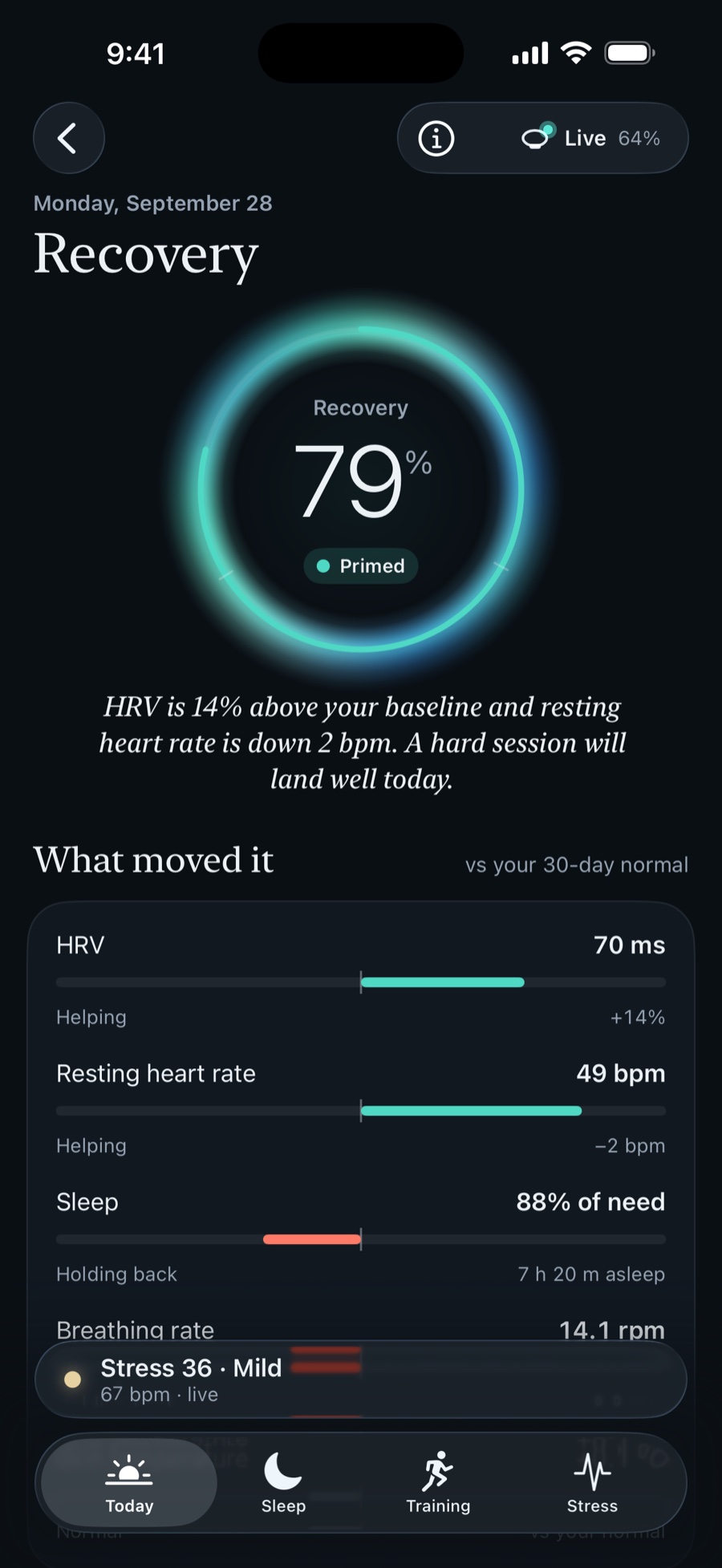
Keely’s Recovery is a score from 0 to 100 %, ready when you wake. It compares last night’s heart-rate variability (HRV), resting heart rate, sleep, breathing rate and skin temperature with your own 30-night normal. A night exactly at your normal scores 50 %.
Updated
- When
- Once a day, as soon as your night has synced
- States
- Primed 67–100, Balanced 34–66, Restore 0–33
- Inputs
- HRV 45 %, resting heart rate 25 %, sleep 20 %, breathing rate 5 %, skin temperature 5 %
- Compared with
- Your own last 30 nights, recent nights weighted more
- First score
- After 3 nights with your Loop; fully personal after 14
- Computed
- On your iPhone, from your Polar Loop’s beat-to-beat data
What Recovery tells you
Recovery answers one question each morning: how did last night compare with what’s normal for you? HRV and resting heart rate carry most of the weight, because they move when your body is still absorbing a hard day, a short night, alcohol, illness or stress.
- Primed 67–100
- Balanced 34–66
- Restore 0–33
Each state comes with a focus for the day, and it sets your Load target:
- Primed, a quality day. Threshold or intervals will land well.
- Balanced, a steady day. Endurance or tempo fits; save the hard intervals.
- Restore, an easy day. A walk, mobility or a short Zone 1–2 session.
Tap the score in the app to see what moved it. Each input shows as helping, holding back or normal, with its value against your normal range.
What goes into it
| Input | Measured as | Weight | Better when |
|---|---|---|---|
| HRV | RMSSD of beat intervals in deep (slow-wave) sleep, or the whole night when deep sleep has too few clean beats | 45 % | Higher |
| Resting heart rate | The lowest 10-minute average overnight | 25 % | Lower |
| Sleep | Time asleep ÷ your sleep need | 20 % | Closer to 100 % |
| Breathing rate | The night’s average | 5 % | At your normal |
| Skin temperature | Difference from your normal | 5 % | At your normal |
HRV here is RMSSD: the root mean square of the differences between successive heartbeats, in milliseconds. It varies widely from person to person, which is why Keely only ever compares you with you.
How the score is computed
- Distance from normal. Each input becomes a z-score: how many standard deviations it sits from your baseline. The sign flips where lower is better, so a positive z always helps.
- Breathing rate and skin temperature only count against you, since a change in either direction can mean something is off.
- Sleep is measured against your need, not your average: 85 % of your need counts −1, and sleeping past your need helps, up to +1.
- Every z is capped at ±2.5, so one strange reading can’t dominate.
- Blend. The z-scores are weighted and added up.
- Score. The blend goes through a logistic curve, so the score moves most around your normal and flattens at the ends.
z        = (value − baseline) ÷ SD
z sleep  = (asleep ÷ need − 1) ÷ 0.15
c        = 0.45 zHRV + 0.25 zRHR + 0.20 zSleep
         + 0.05 zBreathing + 0.05 zTemperature
Recovery = 100 ÷ (1 + e^(−1.6 × c))
A worked example. HRV one standard deviation above normal (+1), resting heart rate half a deviation below (+0.5), 95 % of your sleep need (−0.33), breathing at normal (0) and skin temperature half a deviation off (−0.5). The blend is c = 0.45 + 0.125 − 0.067 + 0 − 0.025 = 0.48, so Recovery is 100 ÷ (1 + e^−0.77) = 68 %, Primed.
Standard deviations have floors, so a run of near-identical nights can’t make small changes look huge: 5 % of the mean for HRV, 1 bpm for resting heart rate, 0.3 breaths a minute and 0.2 °C.
Your normal, and calibration
- Your normal for each signal is a weighted average of your last 30 nights. Recent nights count more: a night a week ago counts half as much as last night.
- The normal range shaded behind HRV and resting heart rate in the app is your baseline ± one standard deviation.
- The first score arrives once HRV and resting heart rate each have 3 nights. Until then Recovery shows Calibrating, never a guess.
- Fully personal after 14 nights. A night never counts toward its own baseline.
When the score arrives
Recovery is computed as soon as your night’s beat intervals and heart rate have synced from the Loop. The Loop’s own sleep staging can take a little while after you wake, and until your night is in, Today says Reading your night rather than showing an early number.
Every morning’s score is kept. The Recovery calendar at the foot of Today shows each one as a ring, and tapping a day shows its numbers.
Frequently asked questions
What is a good Recovery score?
There’s no universal good score, because Recovery compares you only with your own normal. 50 % is an ordinary night for you, 67 % and above is Primed, and 33 % and below is Restore. The trend over a few weeks says more than any single morning.
Why is my Recovery low when I slept well?
Sleep is 20 % of the score. HRV and resting heart rate carry 70 %, and they respond to training, alcohol, illness, heat and stress even after a long night. Tap the score to see which input held it back.
Why does Recovery say Calibrating?
Keely needs 3 nights of HRV and resting heart rate before it knows your normal. Until then it shows Calibrating instead of a score, and the scores firm up over your first 14 nights.
What happens on a night without data?
A missing night stays missing. Keely doesn’t estimate a score it can’t measure. If deep sleep has too few clean beats for HRV, it uses the whole night’s beats instead.
Is Recovery a medical measurement?
No. Recovery is a wellness estimate for training and daily life. It can’t diagnose, treat or rule out any condition. If you feel unwell, talk to a doctor.
Keep reading
We may earn a commission when you buy through this link. As an Amazon Associate, Metrica Fit earns from qualifying purchases. Keely is an independent app and isn’t affiliated with or endorsed by Polar Electro.