From your walks and runs
Fitness: your VO2 max, estimated with care.
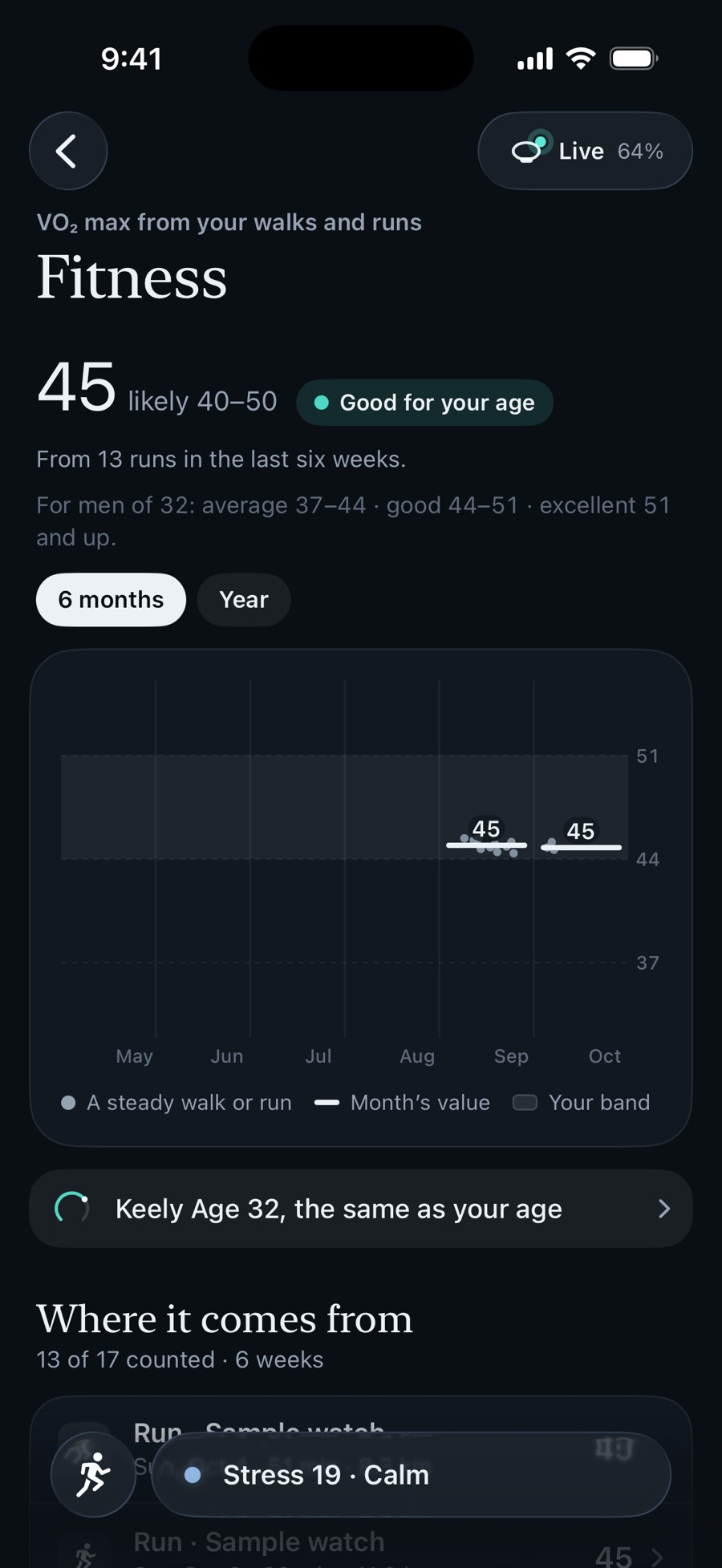
Keely estimates your VO2 max from real effort, never from resting signals. It reads the walks and runs your watch or apps save to Apple Health, takes their pace on steady, level stretches, and puts it against your Polar Loop’s heart rate over the same minutes. You get a number with a likely range and a band for your age and sex, once 3 steady walks or runs agree.
Updated
- Unit
- VO2 max, in ml of oxygen per kg per minute
- From
- The Loop’s heart rate, and the distance of walks and runs in Apple Health
- Needs
- 3 steady walks or runs on at least 2 days, in the last 6 weeks
- Likely range
- 5 either way, or 7 while your max heart rate is estimated
- Bands
- Below average to excellent, for your age and sex (FRIEND)
- Reads
- Distance only. Never your routes or where you were
Why from walks and runs
VO2 max is the most oxygen your body can use, and it’s measured properly on a treadmill with a mask. Wearables estimate it, and in independent tests the estimates that come from real exercise land closer to the lab than those from resting data. So Keely only estimates it from effort: a known pace, held steadily, against the heart rate it took.
The Loop has no GPS, and Keely never asks for your location. The pace comes from the walks and runs that other apps and watches already save to Apple Health, such as a Suunto, Garmin or Apple Watch, Strava or Nike Run Club. Keely reads only their distance over time.
How a walk or run is read
- Steady stretches. Keely looks at minutes 5 to 35: after your warm-up, and before heart rate drifts. A stretch counts when each minute’s pace is within 5 % of its average for at least 3 minutes, with the Loop’s heart rate covering most of it.
- What that pace costs. On level ground, the oxygen a pace costs is well known (the ACSM’s equations, with S in metres a minute):
walking   cost = 3.5 + 0.1 × S
running cost = 3.5 + 0.2 × S- Carried on to your max. Your heart rate says how much of your heart-rate reserve that pace took, between resting and max. Carried on to your max:
VO₂ max = 3.5 + (cost − 3.5) × (max HR − resting HR) ÷ (HR − resting HR)A run counts when its effort sits between 40 % and 95 % of your reserve. Each run’s value is the middle of its stretches, and your fitness is the middle of the last six weeks’ runs.
For example: 10 km/h (167 m a minute) at 150 bpm, with resting at 60 and max at 185, costs 36.8, at 72 % of your reserve, so it reads 49.8.
The two heart rates it needs
- Resting, while awake. Your nights’ resting heart rate, plus how far above it you sit when you’re still and awake. The sleeping value alone would read every effort as harder than it was.
- Max. Yours if you set it in Settings. Otherwise the higher of Tanaka’s estimate for your age (208 − 0.7 × age) and the highest heart rate you’ve held for 30 seconds in a workout. While it’s the estimate for your age, your fitness is marked provisional and its range is wider.
How sure it is
It’s an estimate, and Keely says so. Across independent tests, exercise-based wearable estimates land within about 10 of a lab test for 19 people in 20, and within about 5 for two in three. So Keely gives a likely range of 5 either way, or 7 while your max heart rate is estimated. It needs 3 steady walks or runs on at least 2 days, with most of them within 10 % of each other, before it shows a number at all.
Your band, for your age and sex
Keely places your fitness among the FRIEND registry’s treadmill tests for people your age and sex: below the 25th percentile is below average, then average to the 50th, good to the 75th, and excellent above it.
| Age | Men: 25th · 50th · 75th | Women: 25th · 50th · 75th |
|---|---|---|
| 20s | 40.1 · 48.0 · 55.2 | 30.5 · 37.6 · 44.7 |
| 30s | 35.9 · 42.4 · 49.2 | 25.3 · 30.2 · 36.1 |
| 40s | 31.9 · 37.8 · 45.0 | 22.1 · 26.7 · 32.4 |
| 50s | 27.1 · 32.6 · 39.7 | 19.9 · 23.4 · 27.6 |
| 60s | 23.7 · 28.2 · 34.5 | 17.2 · 20.0 · 23.8 |
| 70s | 20.4 · 24.4 · 30.4 | 15.6 · 18.3 · 20.8 |
Between decades, Keely blends the two around your exact age.
What it leaves out
- Treadmill and indoor sessions. There’s no outdoor pace to read.
- Hills. More than 10 m of climb per kilometre changes what a pace costs.
- Stops and surges. Anything that isn’t a steady stretch.
- Walks too easy to lift your heart rate, under 40 % of your reserve.
- Runs without your Loop’s heart rate. They’re listed, with the reason.
Every walk and run Keely read is on its Fitness page, with its value or why it didn’t count. A run the Loop also recorded opens its workout, which shows the run’s distance and pace.
When it doesn’t apply
Beta-blockers, a pacemaker, atrial fibrillation and pregnancy change how heart rate responds, so the formula doesn’t hold. If one applies to you, turn on Heart-rate medication or condition in Settings, and Keely won’t estimate your fitness. That answer stays on your iPhone.
Private by design
Keely asks Apple Health for one thing, separately from saving: your workouts and the distance you walked and ran. It never reads routes or location. What it reads, and the fitness it works out, stay on your iPhone and aren’t backed up to your account.
Frequently asked questions
Does the Polar Loop measure VO2 max?
In Polar Flow, the Loop estimates it at rest, from a five-minute test lying still. Keely estimates it from effort instead. The Loop has no GPS, so Keely pairs its heart rate with the distance of walks and runs that another app or watch saves to Apple Health.
How do other wearables estimate VO2 max?
Each in its own way: some from a timed walk or run, some from your nights and activity with no workout at all, some from a test at rest. The comparisons set them side by side, with their sources.
What do I need for it?
A Polar Loop, Keely, and something that records outdoor walks or runs with their distance and saves them to Apple Health: a watch, or an app such as Strava or Nike Run Club. Wear your Loop while you go.
Why does it say provisional?
Keely hasn’t seen your max heart rate yet, so it uses the estimate for your age, and the likely range is wider. A hard effort held for 30 seconds, or setting your max in Settings, firms it up.
Do treadmill runs count?
No. Without outdoor distance there’s no pace to read, so indoor sessions are left out.
Does Keely save its VO2 max to Apple Health?
No. Not until Keely’s estimate has been checked against lab tests.
What is Keely Age?
Your fitness in years: the age whose average mortality risk matches fitness like yours. It comes from this VO2 max and nothing else. See Keely Age.
Sources
- The ACSM’s metabolic equations: American College of Sports Medicine, ACSM’s Guidelines for Exercise Testing and Prescription.
- Heart-rate reserve and oxygen uptake: Swain DP et al. Relationship between % heart rate reserve and % VO2 reserve in treadmill exercise. Med Sci Sports Exerc 1998. doi:10.1097/00005768-199802000-00022
- Max heart rate for age: Tanaka H, Monahan KD, Seals DR. Age-predicted maximal heart rate revisited. J Am Coll Cardiol 2001. doi:10.1016/S0735-1097(00)01054-8
- Reference bands: Kaminsky LA et al. Reference standards for cardiorespiratory fitness measured with cardiopulmonary exercise testing (FRIEND). Mayo Clin Proc 2015. doi:10.1016/j.mayocp.2015.07.026
- How accurate wearables are: Molina-Garcia P et al. Validity of estimating the maximal oxygen consumption by consumer wearables (INTERLIVE). Sports Med 2022. doi:10.1007/s40279-021-01639-y
Keely is not a medical device. Its fitness estimate isn’t a diagnosis or a substitute for a test.
Keep reading
We may earn a commission when you buy through this link. As an Amazon Associate, Metrica Fit earns from qualifying purchases. Keely is an independent app and isn’t affiliated with or endorsed by Polar Electro.