All day
Load: effort with no ceiling.
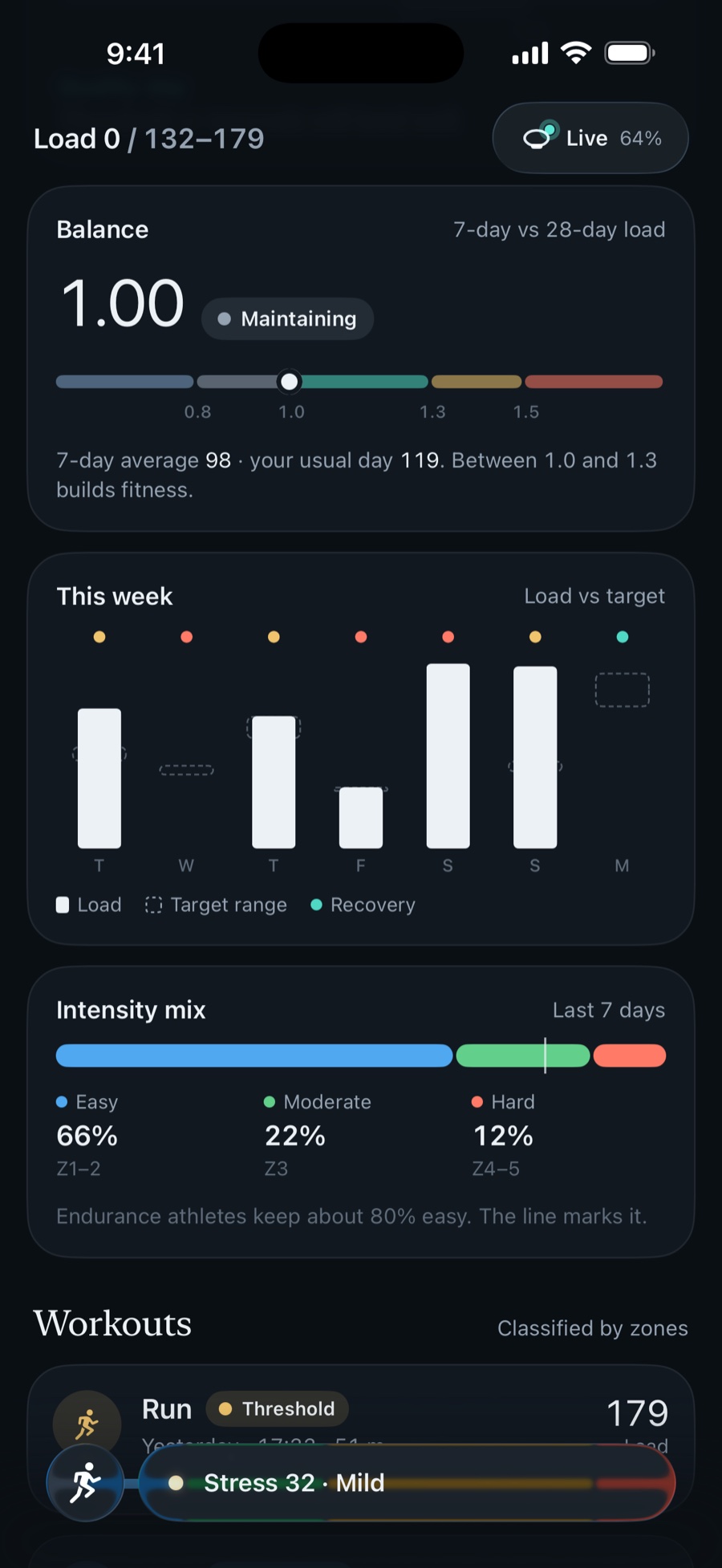
Load is Keely’s measure of effort. It counts every minute by its heart-rate zone, from about 1 point a minute in Zone 1 to about 5 in Zone 5. It’s linear and has no ceiling: twice the work is twice the Load. Each morning you also get a target range for the day.
Updated
- Scale
- From 0, with no ceiling
- Per minute
- Zone 1 ≈ 1 point, up to Zone 5 ≈ 5 points
- For example
- An hour in Zone 2 ≈ 120; three hours ≈ 360
- Daily target
- Set by your Recovery and your last 28 days
- Balance
- Your 7-day average ÷ your 28-day average
- Counts
- From local midnight, from the Loop’s 24/7 heart rate
Why no ceiling
Capped scales, such as a strain score from 0 to 21, get harder to move the higher you go, so a long day and a very long day can end up looking the same. Load stays linear. An hour in Zone 2 is about 120, and three hours is about 360. A 54-minute threshold run is about 175.
Resting doesn’t count: sleep scores 0, and everyday walking rarely registers.
How a minute is counted
Each minute scores by how far your heart rate sits between resting and maximum, its share of your heart-rate reserve:
HRR    = (HR − resting HR) ÷ (max HR − resting HR)
points = 10 × (HRR − 0.45) a minute, from 0 to 5.5
The middle of each zone scores its zone number: Zone 1 about 1 point a minute, Zone 2 about 2, up to Zone 5 at about 5. This is Edwards’ zone-weighted TRIMP, made smooth so there are no cliffs at the zone boundaries. Below 45 % of your reserve, a minute scores nothing.
Heart rate comes from the Loop’s 24/7 recording, a sample every 5 minutes at rest and every second during activity, and from live streaming when Keely is open during a workout.
Heart-rate zones
- Z1 Recovery 50–60 %
- Z2 Endurance 60–70 %
- Z3 Tempo 70–80 %
- Z4 Threshold 80–90 %
- Z5 VO₂ max 90–100 %
Zones are shares of your heart-rate reserve (the Karvonen method), between two anchors:
- Resting heart rate: the average of your last 7 nightly resting heart rates.
- Maximum heart rate: the highest heart rate Keely has seen in a workout. Before your first workout, it uses Tanaka’s estimate, 208 − 0.7 × age.
The app shows where each anchor came from and when, for example “Max 188, observed 14 Sep, hill repeats”.
Today’s target
Each morning Keely sets a range for the day from your usual Load and how recovered you are:
chronic = your average daily Load over the last 28 days
centre  = chronic × (0.2 + 0.014 × Recovery)
target  = centre ± 15 %
At 81 % Recovery the centre is 1.33 times your usual day; at 54 %, 0.96 times; at 23 %, 0.52 times. Until you have 14 days of history, Keely starts from a typical day, a chronic Load of 110, and targets begin after your first Recovery.
Through the day Today tells you where you stand: room for more, in target, or over. Going over on a Restore day comes with a nudge to sleep early.
Balance
Balance compares your last week with your last four: the 7-day average Load divided by the 28-day average, known as the acute:chronic workload ratio. It appears once you have 14 days.
| Balance | Reads as |
|---|---|
| Below 0.8 | Detraining |
| 0.8–1.0 | Maintaining |
| 1.0–1.3 | Building |
| 1.3–1.5 | Overreaching |
| Above 1.5 | Overload |
Workouts
Keely finds workouts in your heart rate, with nothing to start or stop: at least 10 minutes at or above the Zone 1 floor, with dips of up to 2 minutes allowed. Each workout is classed by where its minutes went:
| Class | When |
|---|---|
| VO₂ max | Zone 5 is at least 15 % of the workout |
| Threshold | Zones 4 and 5 together are at least 35 % |
| Tempo | Zone 3 is at least 40 % |
| Recovery | Zone 1 is at least 60 % |
| Endurance | Zones 1 and 2 together are at least 60 % |
| Mixed | Anything else, such as strength training |
Each workout also shows its Load, time in each zone, a recovery time (10 + 0.12 × Load × (1.35 − Recovery ÷ 100) hours) and, when the Loop recorded every second, your 1-minute heart-rate recovery: how far your heart rate fell in the minute after your last hard effort.
Frequently asked questions
How much Load should I do today?
Aim for the target range on Today. It’s set each morning from your Recovery and your last 28 days, so it rises on Primed days and falls on Restore days. Staying in it most days keeps Balance between maintaining and building.
Why didn’t my walk count?
Minutes below 45 % of your heart-rate reserve score nothing, so an easy walk rarely registers. A brisk hike or a hilly walk that lifts your heart rate into Zone 1 does count.
Does strength training count?
Yes, by heart rate. Lifting raises your heart rate less steadily than running, so it usually scores less per hour, and Keely classes it as Mixed.
Why does my target move so much in the first weeks?
Keely needs 14 days of your own Load before the target is personal. Until then it starts from a typical day of 110 and adjusts as your days come in.
Keep reading
We may earn a commission when you buy through this link. As an Amazon Associate, Metrica Fit earns from qualifying purchases. Keely is an independent app and isn’t affiliated with or endorsed by Polar Electro.