Last night
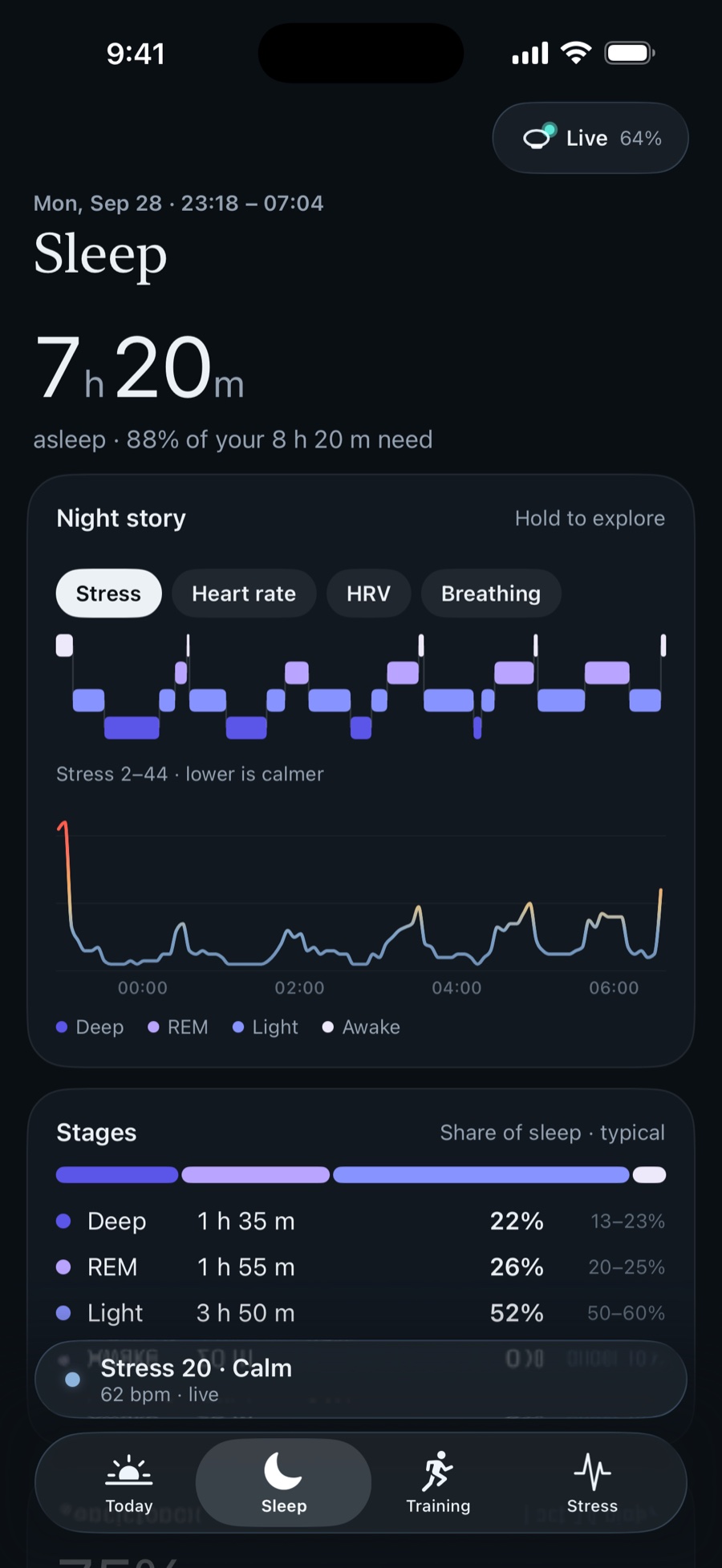
Your night, as a story.
Keely reads your night from the Polar Loop and measures it against what you need. Your need is your sleep goal, plus a share of recent sleep debt, plus a little more after a hard day. Keely also scores how consistent your schedule is and tells you when to turn the lights out tonight.
Updated
- Stages
- Awake, REM, Light and Deep, from the Loop
- Need
- Your goal + recent debt (up to 1 h) + a hard day (up to 30 min)
- Performance
- Time asleep ÷ need
- Consistency
- 0–100, from 14 nights of bed and wake times
- Tonight
- Lights out = usual wake − need − 12 minutes
- Night vitals
- HRV, lowest heart rate, breathing rate, skin temperature, night stress, wake-ups
The night story
- Deep NREM 3
- REM
- Light NREM 1–2
- Awake
Your night is one timeline: sleep stages, with a lane underneath for stress, heart rate, HRV or breathing. Time in each stage sits beside its typical range, and your night vitals sit below: HRV, lowest heart rate, breathing rate, skin temperature against your normal, average night stress and wake-ups.
Stages come from the Loop’s own sleep staging. Keely has its own sleep detection for bands that don’t stage sleep, labelled as Keely’s estimate, but with the Loop the stages are the band’s.
Sleep need
Your need tonight has three parts:
- Your goal. 7 h 50 m unless you change it in your profile, anywhere from 5 to 11 hours.
- Debt. A quarter of what you’ve fallen short of your goal over the last 3 nights, up to an hour.
- A hard day. 40 more minutes for every 100 % you went over yesterday’s Load target, up to 30 minutes.
For example: a goal of 7 h 50 m and three nights of 7 h 20 m, 6 h 40 m and 7 h 50 m leave 1 h 40 m of shortfall, so debt adds 25 minutes. Yesterday’s Load was 250 against a target that topped out at 200, 25 % over, which adds 10 minutes. Tonight’s need is 8 h 25 m.
Performance, and how sleep feeds Recovery
Performance is time asleep divided by need. It’s one of Recovery’s five inputs, worth 20 %: 85 % of your need counts one step against you, and sleeping past your need helps, but only a little. See how Recovery works.
Consistency
A regular schedule helps sleep, so Keely scores it from your last 14 nights of bed and wake times (it needs at least 4):
consistency = 100 − 0.45 × average of
              (|bed − usual bed| + |wake − usual wake|)
Times are in minutes, and “usual” is the median. If your bedtime and wake time each wander about 20 minutes from usual, the score is 100 − 0.45 × 40 = 82. An average wander of 222 minutes scores 0.
Tonight
Keely works backwards from when you usually wake:
lights out = usual wake − tonight’s need − 12 minutesThe 12 minutes are the time it usually takes to fall asleep.
With a usual wake of 06:45 and a need of 7 h 35 m, lights out is 22:58. You can turn on a bedtime reminder for it.
Frequently asked questions
How much sleep do I need?
Your goal is yours to set; Keely starts at 7 h 50 m. Each night it adds back part of any recent shortfall, up to an hour, and a little more after a day that went well over your Load target.
Where do the sleep stages come from?
From the Polar Loop’s own sleep staging, which classifies your night as awake, REM, light and deep sleep from your heart and your movement. Like every wrist-worn tracker, it estimates stages rather than measuring brain activity, as a sleep lab does.
Why did my night take a while to appear?
The Loop hands over your night when your iPhone syncs, and its staging can take a little while after you wake. Until your night is in, Today says Reading your night instead of showing a guess.
Keep reading
We may earn a commission when you buy through this link. As an Amazon Associate, Metrica Fit earns from qualifying purchases. Keely is an independent app and isn’t affiliated with or endorsed by Polar Electro.